
Accidentally leaving a spoon in a bowl or tossing in a foil-wrapped burrito is a common kitchen mishap that often triggers immediate panic. Understanding exactly what happens when you put metal in a microwave is essential for home safety, as the interaction between electromagnetic waves and conductive materials can lead to dangerous outcomes.
While popular culture often depicts these moments as explosive, the reality is rooted in specific physics involving electrical currents and field concentrations. By learning how your kitchen appliance interacts with different materials, you can avoid unnecessary damage to your equipment and prevent potential fire hazards during your daily cooking routines.
The Physics of Microwaves and Conductive Materials
At the core of every microwave oven is a component called a magnetron. This device converts electrical energy into electromagnetic waves, specifically in the microwave frequency spectrum.
These waves are designed to interact with polar molecules, such as water, fat, and sugar, causing them to vibrate rapidly and generate heat. When you introduce a metal object into this environment, you are placing a highly conductive material into a space designed for non-conductive heating.
Metal does not absorb microwave energy in the same way food does. Instead, it acts as a conductor for the electrical currents induced by the electromagnetic field. Because metal has free-moving electrons, the waves cause these electrons to shift back and forth across the surface of the object.
If the metal has sharp edges, thin points, or gaps, the electrical charge cannot distribute evenly. This results in a buildup of high voltage at those specific points, eventually ionizing the air and creating an electrical discharge.
Why Metal Causes Arcing and Sparks
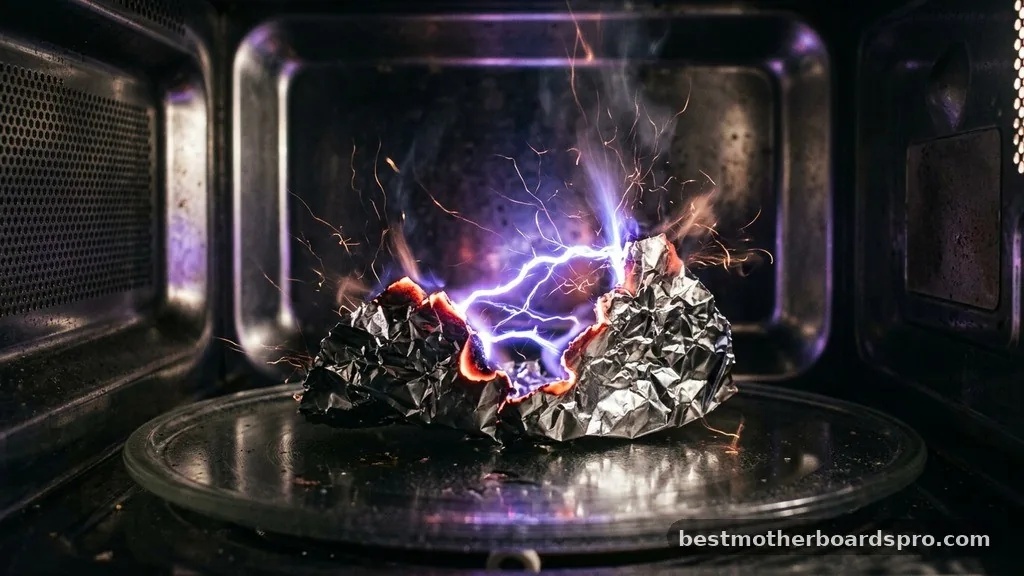
The phenomenon most people fear when they hear a crackling sound inside their oven is known as arcing. Arcing occurs when the induced electrical potential becomes high enough to overcome the dielectric strength of the air, causing a current to jump through the atmosphere. This is the source of the visible sparks you see inside the unit.
Several factors influence the severity of the arcing:
- Geometry of the object: Sharp points, such as the tines of a fork or the crinkled edges of aluminum foil, act as lightning rods that concentrate the electrical charge.
- Proximity to walls: If a metal object is placed too close to the side of the oven, the arc may jump from the metal to the wall of the appliance, which can damage the internal components or the waveguide cover.
- Material thickness: Very thin metal, like the foil found on food packaging, heats up almost instantaneously, which can lead to melting or the ignition of nearby paper or plastic.
Common Myths and Misconceptions
There is a widespread belief that any metal object will cause an immediate, catastrophic explosion. While the risk of fire is very real, the reality is more nuanced. Some metal objects, such as thick, rounded stainless steel spoons or the interior walls of the oven itself, are often perfectly safe because their shape and mass allow them to handle the induced currents without creating dangerous voltage concentrations.
| Item Type | Risk Level | Behavior in Oven |
|---|---|---|
| Smooth, rounded spoon | Low | May reflect waves; generally safe if not touching walls. |
| Crinkled aluminum foil | High | Promotes arcing due to sharp, thin edges. |
| Metal twist ties | High | Can ignite or spark due to thin wire construction. |
| Microwave-safe metal racks | Low | Designed to safely reflect energy; must be used as intended. |
The myth that metal will always ruin the appliance is largely based on poor usage. If you place a metal bowl inside, the waves will simply reflect off the surface. However, if that bowl has a jagged rim or is placed too close to the magnetron output, you risk long-term damage to the internal electronics of the machine.
When Metal is Actually Designed for the Oven

It might surprise you to learn that some microwaves come with metal racks or utilize metallic components in their design. These items are engineered to be safe because they are specifically shaped to minimize sharp edges and are positioned to avoid contact with the oven walls. When manufacturers include these parts, they have accounted for the way electromagnetic waves bounce around the cavity.
If you ever find yourself wondering whether an item is safe, consider the design intent. A metal rack is smooth and sturdy, whereas a disposable aluminum tray or a crumpled candy wrapper is thin and erratic. Never replace a manufacturer-provided rack with a random metal object from your kitchen, as the latter lacks the necessary engineering to manage the energy fields safely.
Topical Gaps: Addressing Hidden Dangers
Many users fail to realize that the danger is not always the metal itself, but what the metal is touching. When a metal object arcs, it generates extreme local heat.
If that object is resting against a plastic container or a paper towel, the heat from the arc can easily ignite the nearby flammable material. This is why many kitchen fires associated with microwaves are actually caused by the secondary ignition of packaging rather than the metal object itself.
Another overlooked issue involves the “hidden” metal in modern conveniences. Some “microwave-safe” snack pouches contain thin layers of metallized film designed to crisp food. These are specifically formulated to handle the energy safely.
However, if you attempt to replicate this by using standard household foil, you will likely experience sparks. Always trust the labeling on food packaging rather than assuming all metallic-looking materials perform the same way.
Preventing Kitchen Mishaps
To keep your kitchen safe, maintain a strict policy regarding what goes into your appliance. If you are unsure about an item’s safety, it is always better to transfer the food to a ceramic or glass container. Avoiding the risk entirely is the most effective way to ensure your appliance lasts for years and your food is heated evenly.
- Inspect containers for hidden metallic trims or gold-leaf patterns.
- Keep the interior of your machine clean, as food debris can act as a bridge for electrical arcs.
- Ensure that any provided metal racks are properly seated in their brackets.
- Remove all wire twist ties from bread bags before reheating.
Frequently Asked Questions
Can I safely leave a metal spoon in the microwave for a short period?
While a smooth, rounded spoon is often safe because it lacks sharp edges, it is generally discouraged. If the spoon is positioned in a way that concentrates the electromagnetic field or touches the oven wall, it can still trigger arcing and potentially damage the internal components of the unit.
What should I do if my microwave starts sparking?
If you see sparks, immediately turn off the machine or open the door to stop the cycle. Do not attempt to touch the metal object until it has had time to cool down, as the concentrated electrical discharge can make the metal surface extremely hot to the touch.
Does putting metal in the microwave contaminate my food?
No, the sparking process does not release toxic chemicals into your food. The primary risks are the physical damage to the appliance, the potential for a fire, and the possibility of the metal object becoming hot enough to burn you or melt the container holding your meal.
Are all metal-rimmed dishes dangerous?
Dishes with thin metallic or gold trim are often dangerous because the metallic layer is very thin and prone to breaking during heating. This creates the exact conditions necessary for arcing. It is best to avoid using any decorative plates with metallic patterns to prevent potential damage to your dishes and oven.
Maintaining Your Appliance for Longevity
When you understand what happens when you put metal in a microwave, you gain the knowledge to protect your appliance and your home. The interaction between waves and conductive materials is a fascinating study in physics, but it is one that is best observed from a safe distance rather than inside your kitchen. By avoiding materials that promote arcing—such as thin foils and sharp-edged utensils—you keep your machine running efficiently.
Always prioritize using verified microwave-safe containers to ensure that your heating process remains smooth and hazard-free. If you keep these safety tips in mind, you will continue to enjoy the convenience of your kitchen tools for many years to come without any unwanted sparks or surprises.